Guide · September 18, 2026
Pi CLI GUI: Run the Pi Coding Agent Without the Terminal
Prefer buttons to bash? PiLot Studio gives the pi CLI a complete graphical interface in VS Code — sessions, providers, packages, and voice input. Here is what changes when Pi gets a GUI.
Terminal interfaces are efficient — once you know them. But a large part of what an AI coding agent does is conversational: reviewing a diff, re-asking with more context, trying another model. Those loops feel better with a cursor, a click target, and a scroll-back history. That is the gap PiLot Studio fills: it is a Pi CLI GUI embedded in VS Code.
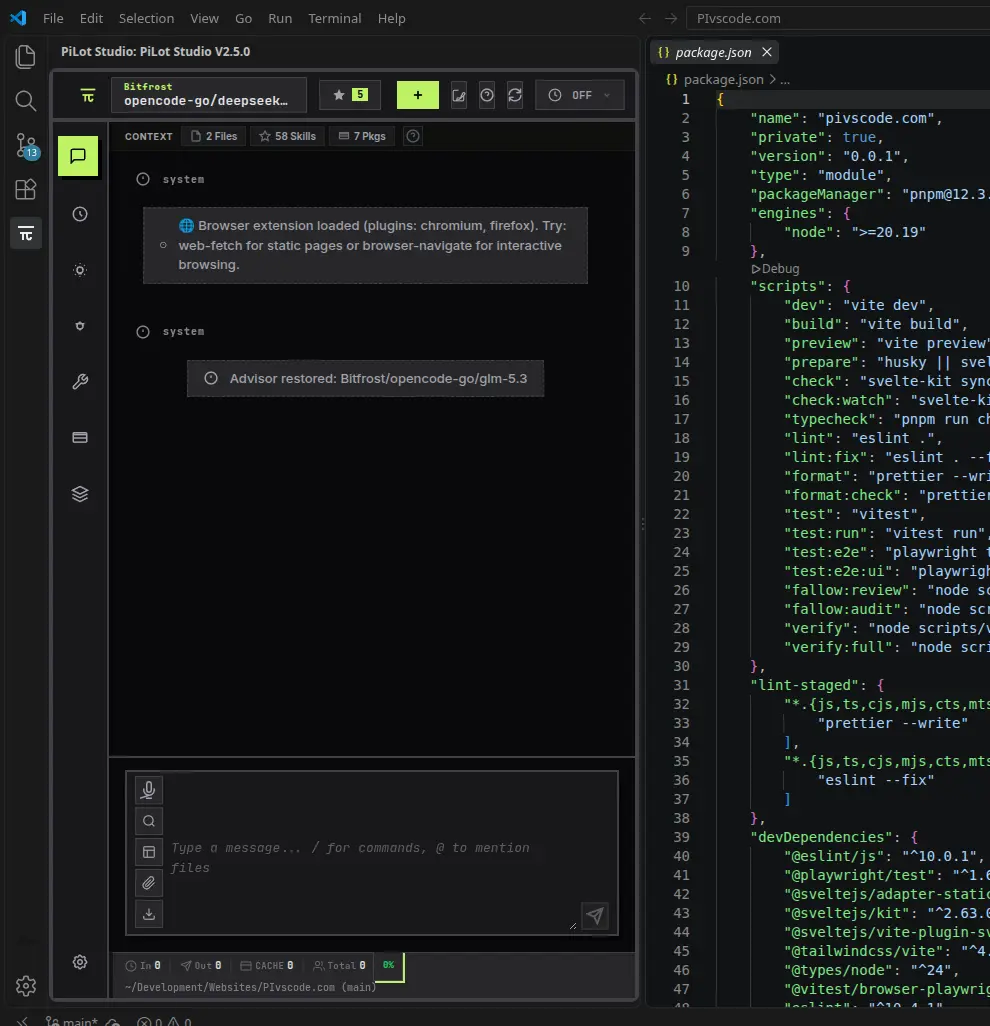
What the GUI adds to the pi CLI
- Visible context. The context bar shows exactly which files and skills the agent sees — no more guessing what's in scope.
- One-click models. Cycle providers per message. Claude for architecture, a local Ollama model for boilerplate — same conversation.
- Session history. Every conversation is kept in a tree. Click to reopen yesterday's work; export any session to Markdown or JSON.
- Voice input. Built-in, offline dictation for hands-free prompting.
- Package management. Install, update, disable, and remove Pi packages and skills from a visual manager.
What stays from the CLI
Under the hood PiLot Studio is the pi CLI — it launches and manages the binary for you. Slash commands, @ file mentions, thinking-level control, and headless usage all behave as documented upstream. The GUI is additive, not a fork.
Who is this for?
If you live in VS Code and want an AI coding agent without the terminal — whether because you're new to agentic tools, you switch machines often, or you simply think visually — PiLot Studio is the Pi coding agent frontend you're looking for. Set it up in five minutes →